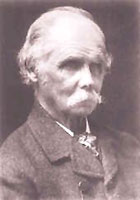
Biography
Marshall was an academic throughout his life. He wrote in a simple style and believed that mathematical explanations were over-used and often unnecessary.
Neo-Classical Economics
Classical and Marxist traditions were interested in long term change and the distribution of income among the different groups in society. Neo-classical writers took a more optimistic approach. Economic expansion seemed to be assured. Population was not out of control and the real wages of the working class were omproving. Progress appeared to resolve social tensions not aggravate them.
The attention of economists therefore shifted to the analysis of particular decision-making units rather than the system as a whole. The theory of the market price received more attention. In neo-classical economics, the determination of market prices became the problem and the concept of demand as a result of price and quantity was crucial.
Marshall wrote in a clear and polished style. He stated that mathematical explanations that aided the economist in his thinking were not helpful in communicating his findings to others. Most of Marshall's teaching was published in one book: Principles of Economics, published first in 1890.
Analysis of Price
Consumers sought maximum satisfactions and supplier sought maximum rewards. Normally it could be expected that buyers would be prepared to purchase more of a particular good at lower prices than at higher ones. This emphasis on demand side of price formation changed the face of economics. Most classical writers stressed the supply side and that economic value could only be given to tangible products. Classical ideas about productive and unproductive labour were eliminated.
"It is sometimes said that traders do not produce: that while the cabinet-maker produces furniture, the furniture-dealer merely sells what is already produced. But there is no scientific foundation for this distinction. They both produce utilities, and neither of them can do more .... We may define labour as any exertion of mind or body undergone partly or wholly with a view to some good other than the pleasure derived directly from the work .... it would be best to regard all labour asproductive except that which failed to promote the aim towards which it was directed, and so produced no utility. "
Supply & Demand
Price was able to be found at the intersection (the equalibrium) of the supply and demand curves. A price above the equalibrium would mean that suppliers were offering more than buyers would take leading to a lowering of the offering price. On the other hand, an asking price lower than equalibrium would lead to frustrated buyers bidding the price towards equalibrium.
This now seems self-evident to economics students. But when Marshall suggested this approach it was a real innovation. It was a major change from the classical and Marxian approach to value as based on labour. It was also a counter to other neo-classical writers, such as Jevons, who suggested that utility and demand only determined value. Demand (based on utility) and supply (based on costs of production) were both necessary. The difference between value (the 'natural price') and the market price disappeared. The search for a measure of value stopped - price determined by the competitive market was the important thing.
Profits and Wages
The difference between wages and profits began with the classical writers and emphasized by Marx also disappeared. Marshall defined wages as the reward for human effort. This meant that wage payments were not only paid to workers but also salary income and wages to management was included. Much of the income earlier tradtions had described as profits was now included in wages to management.
Attack on Marxism
Marshall gave legitimacy to income derived from property. This led him to be critical of Marx's narrower definition of labour and of Marx's championong of the worker. Marshall wrote:
"It is not true that the spinning of yarn in a factory, after allowance has been made for wear-and-tear, of the machinery, is the product of the labour of the operatives. It is the product of their labour, together with that of the employer and subordinate managers, and of the capital employed; and that capital itself is the product of labour and waiting;and therefore the spinning is the product of labour of many kinds, and of waiting. If we admit that it is the product of labour alone ... we can no doubt be compelled by inexorable logic to admit that there is no justification of interest, the reward for waiting; for the conclusion is implied in the premiss."
Time Periods
According to neo-classical thinking, individual business people were rational calculators seeking to maximize their earnings. Business people would respond rationally to changes in market circumstances. This led to the study of the reactions of business people to different, small changes assuming ceteris paribus : that all the other underlying factors remain the same.
This led Marshall to distinguish between 3 time periods: (1). the 'market period', (2) the 'short run', and (3) the 'long run'. Classical writers did use similar time periods but they used them differently. However, Marshall's time periods were not fixed to any fixed calendar periods. The long run, for example, was the time period necessary to allow an industry to adjust the scale of plant necessary to produce a new market equalibrium after an earlier one has been disturbed.
Economy of Scale & Competition
Changes of scale lead to different possible outcomes. One interesting case is one in which average costs decline as plant scale increases. This is described as"increasing reurns of scale". Mill and Marx both saw this effect but did not fully describe it. Economies of scale implied that a small number of large producers could operate with a lower unit cost than than could a large number of smaller firms ceteris paribus . Therefore, perhaps the major assumption of the competitive market was being challenged by itself.
Marshall thought that when theory and realism conflict, ordinary observation should come first. He thought that individual firms, in a theoretical "special" market, would behave according to the economies of scale. But, in reality, there is a general market with all kinds of changing factors. Firms are like biological organisms. Firms, like animals, have life cycles of expansion, decline and death. Companies may expand to a point but then lose the vigour of those who led it in the times of expansion. Firms (like the Roman Empire) may also become so large that they become unable to respond to all changes.
These ideas led Marshall to be optimistic. Economies of scale were unlikely to challenge a severe challenge to competition. The 'special markets' within which firms could enjoy unique privileges can not be maintained.
Macro Economic Questions
Marshall was mainly concerned with micro-economic questions and the determination of price levels.But he was also concerned with macro economic questions. His analysis of the general price level was important. It was developed around the "quantity theory" of money. He said that the amount of money held was regulated by by institutional arrangements of the economy and, ceteris paribus , was constant:
"... if everything else remains the same, then there is this direct relation between the volume of currency and the level of prices, that, if one is increased by 10%, the other also will be increased by 10%"
The effect of this was to reinforce the essential requirements of Say's Law: that all income would be spent. Leakages into idle balances could, for practical purposes, be ignored.
This did not mean economic instability was not possible. Marshall thought the main reason for fluctuations was the psychology of the business community. When business people were bullish the demand for loans increased. This may lead to investment in high risk under-takings, many of which may fail. And when they fail the "bubble" is pricked. Pessimism replaces optimism.
Credit cycles, however, still did not mean that temporary over-production would lead to general over-production. The economy would adjust. No special action on the part of government was necessary. Government action could make things worse although the government could flatten out the fluctuations. He gave some role to government and foreshadowed the attacks launched by Keynes.
Conclusion
Because of the times in which he lived, Marshall could see that the gloomy predictions of Malthus, Ricardo and Marx could be rejected (at least for the time being). Despite increases in population real wages had increased. Capital accumulation continued but it did not displace labour. Nor did the increase in demand for foodstuffs give landlords a stranglehold over the economy. Marshall did not accept Malthusian type "iron laws". He followed Mill's path - believing that population would stop improvements in real wages. Like Mill, he had some optimism in the effects of a growth in the skills, energies, self-respect and education levels of people.Competition between capital and labour would be off-set by growth in demand for workers in expanding industries. The cost cutting effects of machines were good because competition would mean that price reductions were shared.